Chop Hop
Tap to flip. Slice everything. Mind the pink.
Leaderboard
Loading…
More games
All games →
Tilt
Run · 3 stages
Flapjack
Run · 3 stages
Twist
Run · 3 stages
Seesaw
Daily · timed
Burst
Levels · endless
Eyeball
Daily · five figures
Putt
Quick · 3 holes
Holdout
Quick · 8 waves
Mix
Daily · five colours
Odd Coin
Daily · par
Fold
Daily · par
Ferry
Daily · par
Tempo
Daily · five beats
Corridor
Daily · 8 waves
Sky Skate
Run · 45 s
Rally
Quick · to 5
Fore
Round · 3 holes
Count Rush
45 seconds
Word Six
Daily · unlimited
Sudoku
Daily · unlimited
Mini Crossword
Daily · archive
Minesweeper
Quick play
Color Flood
Daily · challenge
Block Fit
Endless
Number Rush
60 seconds
2048
Quick play
Memory
Quick play
Snake
Quick play
Chess
vs computer
Hex Settlers
vs bots
Four in a Row
vs computer
Tic-Tac-Toe
vs computer
Isolate
vs computer📖 Strategy guide: Chop Hop by the numbers: the hop, the double tap and the nearly free ×10
How to play
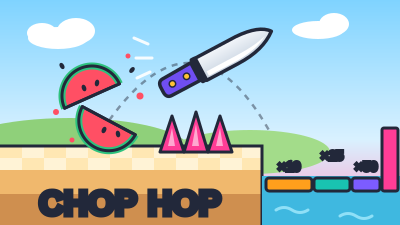
You have seen this one in an ad: a knife flies forward by itself, every tap flips it, and it slices whatever it passes. Here it is with real rules. Tap anywhere in the box, on the ground or in the air, and the knife jumps and turns one full flip. That is the whole gesture. On a keyboard, Space, the up arrow, W or Enter do the same. The knife slides on at a fixed speed, so the only thing you decide is when.
Fruit, cake, cash and gems hang in arcs along the path a single hop takes: tap at the right moment and one flip slices the whole arc, each one splitting in two. Pink is the enemy. A row of pink spikes on the floor, a pink block with spikes on top, or a pink beam hanging from the sky costs you a knife; so does dropping into the water of a gap. You have three knives for the whole run. For a second after a loss the knife is a ghost: it cannot be hurt and cannot slice. Lose the third knife and the run ends with whatever you banked so far.
Three stages, three boards
A run is three stages of about fourteen seconds each. The Picnic runs at 5 units a second with fruit only, five spikes and two gaps; the Kitchen is a little faster, adds cake worth 20, two spiked blocks and two beams; the Vault is faster again and pays in cash (50) and gems (100), with three blocks, three beams and two arcs of cash and a gem hanging high, where only a double tap reaches. Nothing dangerous sits in the last five units of a stage, so you arrive at the ledge in control.
Every stage ends on a landing board two units below the ledge: planks painted ×2, ×3, ×5, ×10, ×25 and ×50, each narrower than the last, then a pink wall. The points you sliced in that stage are multiplied by the plank you land on and banked. Overshoot into the wall and the stage pays ×1. On the Vault's board a thin pink divider stands at every edge between two planks; land on one and the stage pays ×1 too, though it never costs a knife. The knife sticks in the plank, the number pops, and the next stage starts.
Scoring and stars
Fruit is 10, cake 20, cash 50, a gem 100. The slices of one flip count up: the first pays ×1, the second ×2, the third ×3, up to ×5. The opening arc of four fruit is 10 + 20 + 30 + 40 = 100 points from one tap, on every run. A new tap starts the count over, and a slice taken while sliding on the ground pays ×1. A stage's points times its plank is its bank; the run's score is the three banks added up.
The bot's score on the same three stages is the par. Three stars for a score at or above par, two for finishing all three boards with at least half of it, one for finishing, none for running out of knives. Beat the par and the card says so.
The timing, by the numbers
At the Picnic's speed a hop lasts 0.72 seconds, carries the knife 3.6 units and peaks 1.4 units up. A spike row 0.6 units wide gives you a third of a second in which a tap clears it; the Vault's 1.2 unit rows at 6 units a second give you 0.27 seconds. A gap is kinder than it looks: even once the knife has started to fall, a tap within the next 0.28 seconds still carries it out. A spiked block is too tall for one hop: tap, then tap again a quarter of a second later, while the knife is still rising.
On the board, slide off the ledge without tapping and you land 2.2 units out, on ×2. Tap once at the ledge: 4.6 units, ×3. A second tap in the air lands on ×5 when it comes 0.2 to 0.48 seconds after the first, and on ×10 anywhere from 0.5 to 0.9 seconds, because the landing distance peaks at 8.3 units and comes back. ×25 and ×50 need a third tap taken just above the planks: after a second tap at 0.6 seconds, ×25 is a 67 millisecond window and ×50 the 100 milliseconds right after it; any later and the knife sails into the wall. Tap without pause and the knife climbs to the top of the sky and lands in the wall every time.
Daily, par and challenges
Every run is laid out from a seed number: where the spikes, gaps, blocks and beams stand, where the arcs hang, what they hold. Before you ever see a stage, a bot plays it with the game's own code: a search over tap times, every fifteenth of a second, that slices what it can, never loses a knife and never aims past ×10. It plays a meaner version of the course (the pink a little bigger, the planks a little narrower), so its line works on yours with room to spare. A stage the bot cannot finish is thrown away and drawn again. The bot's replayed score is the par on your result card, so the par is always a line that really exists on your run. Match its slicing and dare a ×25 or a ×50 to beat it. The Daily takes its seed from the date and is the same three stages for everyone until midnight UTC. Run draws a fresh seed every time; ⚔️ copies a link to the run you are on so a friend faces exactly the same course.
Tips
- The fruit over a spike or a gap is hung along the hop that clears it. Tap just before the knife reaches the first fruit and the hazard takes care of itself.
- A spiked block needs the double tap. The cash and gem arcs high in the Vault hang exactly on that second flip, so the richest items in the game are the ones that need the trick.
- Under a pink beam, one hop only: a double tap reaches it. A beam over a spike row is a tunnel, and a plain hop threads it.
- On the board, do not mash. One tap at the ledge, a second when the knife is back at the ledge's height, and ×10 is nearly automatic. Save the third tap for a stage whose points are worth the gamble.
How this one is made
The whole game is a deterministic simulation that runs sixty steps a second, and the bot plays the same simulation. Over 100 random runs the bot banked between 29,000 and 37,400 points (median 32,100): it sliced every item and landed ×10 on all 300 boards. It finishes a freshly drawn stage 97 % of the time, so a redraw is rare, and a fallback stage never happened in 600 stages or in 60 dailies (whose pars run from 29,000 to 36,200). For comparison, on the same runs: a knife that never taps loses all three knives in the Picnic by the 31st unit on average, about six seconds in, and scores 0. A knife that taps every half second never touches the floor, so it gets through the Picnic, then hits the Kitchen's beams: it finished none of the 100 runs and banked about 110 points. A knife that taps as fast as the game allows loses its first knife in the Kitchen every time. And a stronger search than the bot's, allowed to go for ×50 on every board, scored at least the par on all 50 runs it played and five times the par on average: the par is beatable, and the boards are where it happens.